How Is Sound Measured: Complete Guide to Sound Measurement 2025
Sound measurement is essential for understanding audio levels in our environment. Sound is measured using two primary units: decibels (dB) for intensity and hertz (Hz) for frequency. Professional sound measurement requires specialized instruments like sound level meters and spectrum analyzers to accurately capture both the loudness and pitch characteristics of acoustic waves.
What Are the Primary Units Used to Measure Sound
Understanding sound measurement units is fundamental to acoustic analysis. The most common measurement system uses decibels for sound intensity and hertz for frequency. These two measurements work together to provide a complete picture of any acoustic signal, from whispers to jet engines.
The decibel scale is logarithmic, meaning each 10 dB increase represents a tenfold increase in sound intensity. Meanwhile, hertz measures the number of sound wave cycles per second, determining the pitch we perceive. A typical conversation occurs around 60-65 dB, while frequencies range from 85 Hz for deep bass to 1,100 Hz for normal speech.
Decibels: Measuring Sound Intensity and Loudness
The decibel measurement system quantifies sound intensity levels using a logarithmic scale based on human hearing perception. Zero decibels represents the threshold of human hearing, while sounds above 85 dB can cause hearing damage with prolonged exposure. In 2024, OSHA regulations in the United States limit workplace noise exposure to 90 dB over an 8-hour period.
Hertz: Understanding Sound Frequency Measurement
Frequency measurement in hertz determines the pitch characteristics of sound waves. Human hearing typically ranges from 20 Hz to 20,000 Hz, with sensitivity peaking around 2,000-4,000 Hz. Musical instruments demonstrate this range clearly: a bass guitar’s low E string vibrates at 41.2 Hz, while a piccolo can reach frequencies above 4,000 Hz.
Essential Instruments for Sound Measurement
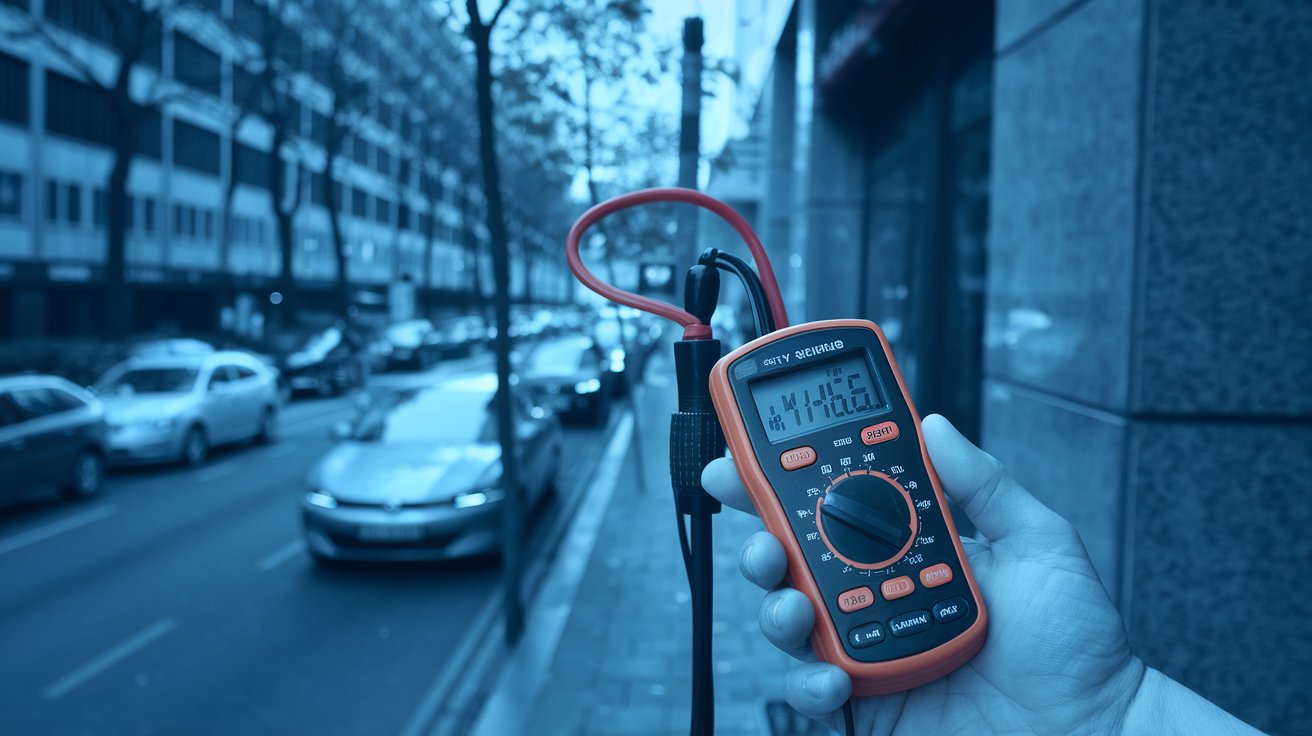
Professional sound measurement instruments provide accurate readings for various acoustic applications. Sound level meters, spectrum analyzers, and oscilloscopes each serve specific measurement purposes, from basic noise monitoring to detailed frequency analysis.
Modern digital instruments have revolutionized acoustic measurement accuracy. Type 1 sound level meters, meeting IEC 61672 standards, offer precision within ±0.7 dB for professional applications. These instruments incorporate sophisticated filtering and averaging algorithms to provide reliable measurements even in challenging acoustic environments.
Sound Level Meters for Decibel Measurement
Sound level meters are the primary instruments for measuring sound intensity in decibels. Professional-grade meters feature A, C, and Z frequency weightings to match human hearing perception or capture flat frequency response. Class 1 meters provide laboratory-grade accuracy, while Class 2 meters offer sufficient precision for most industrial and environmental applications.
Spectrum Analyzers for Frequency Analysis
Spectrum analyzers break down complex sounds into their frequency components, displaying the amplitude of each frequency band. Real-time analyzers (RTAs) provide immediate feedback for audio system tuning, while FFT analyzers offer detailed frequency analysis with high resolution. Modern smartphone apps can perform basic spectrum analysis, though professional instruments remain essential for critical measurements.
How Sound Waves Are Measured and Analyzed
Understanding sound wave measurement requires knowledge of amplitude, frequency, and phase relationships. Sound waves consist of alternating high and low pressure regions that travel through air at approximately 343 meters per second at room temperature. Measurement systems capture these pressure variations and convert them into meaningful acoustic data.
Digital measurement systems sample sound waves at rates typically between 44.1 kHz and 192 kHz, ensuring accurate capture of all audible frequencies. The Nyquist theorem dictates that sampling frequency must be at least twice the highest frequency being measured to avoid aliasing distortion.
Understanding the Difference Between Sound Levels
The difference between sound levels follows logarithmic principles that may seem counterintuitive. A 10 dB increase represents a doubling of perceived loudness, while a 20 dB increase sounds four times louder. This logarithmic relationship means the difference between 20 dB and 30 dB represents the same perceived change as between 70 dB and 80 dB.
Practical examples help illustrate these differences: a quiet library measures around 40 dB, normal conversation reaches 60 dB (four times louder than the library), and city traffic peaks at 80 dB (sixteen times louder than the library). Understanding these relationships is crucial for noise control and hearing protection planning.
Maximum Sound Levels and Physical Limitations
The loudest possible sound in Earth’s atmosphere is theoretically limited to 194 dB. At this level, sound waves create pressure variations so extreme that they form shock waves rather than traditional acoustic waves. This limit exists because sound waves cannot create pressure lower than zero (perfect vacuum) in the rarefaction phase.
In practice, sounds approaching this theoretical maximum include rocket launches (180-200 dB), volcanic eruptions (180+ dB), and nuclear explosions. The 1883 Krakatoa volcanic eruption reportedly reached 180 dB and was heard 3,000 miles away, demonstrating the immense energy involved in extreme sound levels.
Sound Measurement in Different Applications
Sound measurement applications vary significantly across industries and environments. Environmental noise monitoring requires long-term averaging and specific frequency weightings, while audio engineering demands precise frequency analysis and real-time feedback capabilities.
Building acoustics measurements focus on reverberation time, sound transmission class ratings, and impact noise levels. The International Organization for Standardization (ISO) provides specific measurement standards for each application, ensuring consistency and reliability across different measurement scenarios.
Speaker and Audio System Measurement
Measuring sound in speakers requires specialized techniques including frequency response testing, distortion analysis, and impedance measurements. Professional audio measurements use calibrated microphones positioned at specific distances and angles to capture accurate performance data. Anechoic chambers eliminate room reflections for precise speaker characterization.
Environmental and Occupational Sound Monitoring
Environmental sound measurement follows EPA and local regulations for noise pollution assessment. Occupational measurements must comply with OSHA standards, requiring dosimetry monitoring for workers exposed to varying noise levels throughout their shifts. Modern monitoring systems provide continuous data logging with automated reporting capabilities.
Advanced Sound Measurement Techniques
Modern advanced sound measurement incorporates digital signal processing, artificial intelligence, and cloud-based analysis platforms. Machine learning algorithms can identify specific sound sources within complex acoustic environments, while advanced filtering techniques separate desired signals from background noise.
Psychoacoustic measurements consider human perception factors beyond simple decibel levels. Metrics like loudness (measured in sones), sharpness, and roughness provide insights into how sounds affect human comfort and well-being. These measurements are increasingly important for product design and environmental impact assessment.
Common Sound Measurement Challenges and Solutions
Accurate sound measurement challenges include background noise interference, environmental factors, and instrument calibration requirements. Wind noise, temperature variations, and electromagnetic interference can significantly affect measurement accuracy, requiring specialized windscreens, temperature compensation, and proper grounding techniques.
Calibration procedures ensure measurement accuracy over time. Professional instruments require annual calibration using certified acoustic calibrators that produce known sound levels at specific frequencies. Field calibration checks before and after measurements verify instrument performance and data reliability.
Related video about how is sound measured
This video complements the article information with a practical visual demonstration.
Everything you need to know about how is sound measured
How do we measure sound in everyday situations?
Sound is measured using decibels for loudness and hertz for frequency. Smartphone apps can provide basic sound level measurements, typically ranging from 30-40 dB in quiet rooms to 70-80 dB in busy environments. Professional measurements require calibrated sound level meters for accurate readings.
What is the difference between 20 dB and 30 dB sound levels?
The difference between 20 dB and 30 dB represents a significant increase in sound intensity. Due to the logarithmic nature of the decibel scale, 30 dB is approximately twice as loud as 20 dB to human perception, and ten times more intense in terms of actual sound energy.
What is the main unit used to measure sound?
Sound is measured using two primary units: decibels (dB) for sound intensity or loudness, and hertz (Hz) for frequency. Decibels measure the amplitude of sound waves, while hertz measures how many wave cycles occur per second, determining the pitch we hear.
Why is 194 dB considered the loudest possible sound?
194 dB represents the theoretical maximum sound level in Earth’s atmosphere because sound waves cannot create pressure lower than absolute zero (perfect vacuum). Beyond this level, acoustic energy forms shock waves rather than traditional sound waves, making 194 dB the physical limit for sound propagation.
Is sound measured in hertz or decibels?
Sound is measured in both hertz and decibels, as they measure different aspects. Hertz measures frequency (pitch), typically ranging from 20 Hz to 20,000 Hz for human hearing. Decibels measure intensity (loudness), with normal conversation around 60-65 dB and pain threshold at approximately 120 dB.
What instruments are used to measure sound waves?
Professional sound measurement uses sound level meters for decibel readings, spectrum analyzers for frequency analysis, and oscilloscopes for waveform visualization. Modern instruments often combine multiple measurement functions, providing comprehensive acoustic analysis with digital processing and data logging capabilities.
| Measurement Type | Unit & Range | Practical Application |
|---|---|---|
| Sound Intensity | Decibels (0-194 dB) | Noise monitoring, hearing protection |
| Sound Frequency | Hertz (20-20,000 Hz) | Audio system tuning, music production |
| Professional Measurement | ±0.7 dB accuracy | Compliance testing, research analysis |
| Environmental Monitoring | Long-term averaging | EPA compliance, community planning |