Acoustic Reflex Threshold: Testing, Normal Values & Results
The acoustic reflex threshold (ART) is a crucial audiometric test that measures the lowest sound intensity level at which the stapedius muscle contracts in response to acoustic stimulation. This test provides valuable information about the integrity of the auditory pathway from the cochlea to the brainstem, helping audiologists diagnose various hearing disorders and middle ear pathologies. Understanding acoustic reflex threshold values is essential for comprehensive hearing assessments and determining appropriate treatment approaches.
What is Acoustic Reflex Threshold Testing
Acoustic reflex threshold testing is an objective audiometric procedure that evaluates the automatic muscular response of the middle ear to loud sounds. During this test, the stapedius muscle contracts reflexively when exposed to intense acoustic stimuli, typically between 70-100 dB HL above hearing threshold. This reflex serves as a protective mechanism for the inner ear, reducing the transmission of potentially damaging loud sounds.
The acoustic reflex pathway involves multiple anatomical structures including the cochlea, eighth cranial nerve, ventral cochlear nucleus, superior olivary complex, facial nerve nucleus, and the stapedius muscle. This complex neural network makes the test valuable for identifying retrocochlear pathologies, facial nerve disorders, and middle ear dysfunction. In 2024-2025, advanced tympanometers with automated ART capabilities have made this testing more efficient and accurate in clinical settings across the United States.
How Acoustic Reflex Testing Works
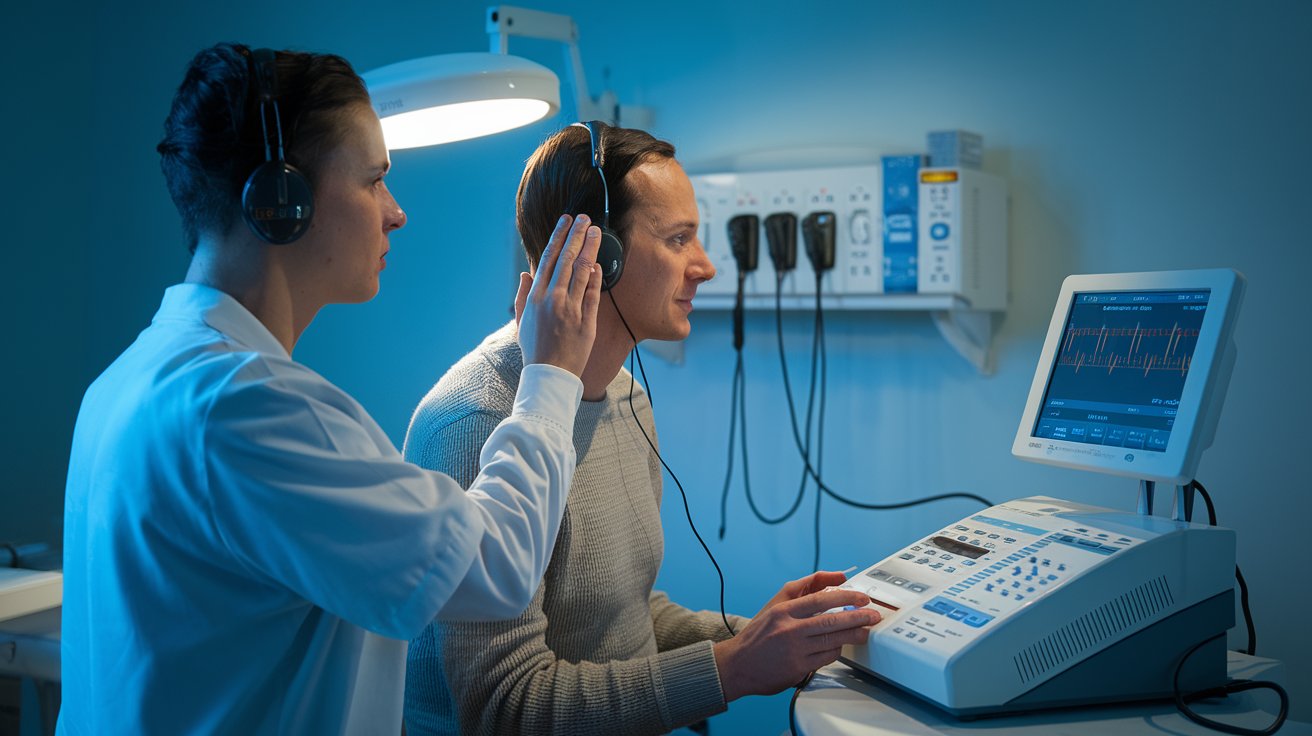
The testing procedure involves placing a probe in the ear canal that simultaneously delivers acoustic stimuli and monitors changes in ear canal volume. When the acoustic reflex occurs, the stapedius muscle stiffens the ossicular chain, causing a measurable change in acoustic impedance. Modern equipment can detect impedance changes as small as 0.02 acoustic ohms, providing highly sensitive measurements of reflex activity.
Types of Acoustic Reflex Measurements
Clinical protocols typically include both ipsilateral and contralateral acoustic reflex threshold measurements. Ipsilateral testing stimulates and monitors the same ear, while contralateral testing stimulates one ear and monitors the reflex in the opposite ear. Additionally, acoustic reflex decay testing evaluates the sustainability of the reflex over time, which is particularly important for detecting retrocochlear pathologies.
Normal Range for Acoustic Reflex Test
The normal range for acoustic reflex thresholds varies depending on the frequency and type of stimulus used. For pure tones, normal thresholds typically range from 70-100 dB HL above the individual’s hearing threshold. For broadband noise stimuli, thresholds are generally 65-85 dB sensation level. These acoustic reflex threshold normative values have been established through extensive research on healthy populations across different age groups.
Recent studies conducted in the United States between 2023-2024 have refined these normative data, showing slight variations based on demographic factors. Adults aged 18-40 years typically demonstrate thresholds within 85-95 dB HL for 1000 Hz stimuli, while older adults may show elevated thresholds up to 105 dB HL. Children and adolescents often exhibit more robust reflexes with thresholds at the lower end of the normal range.
Frequency-Specific Normal Values
Normal acoustic reflex threshold values differ across frequencies, with 1000 Hz typically showing the most robust responses. At 500 Hz, normal thresholds range from 85-105 dB HL, while 2000 Hz and 4000 Hz stimuli typically elicit reflexes at 80-100 dB HL. These frequency-specific variations reflect the natural sensitivity characteristics of the auditory system and the mechanical properties of the middle ear structures.
Age-Related Normative Considerations
Age significantly influences acoustic reflex threshold normative values, with presbycusis and age-related changes in middle ear mechanics affecting reflex sensitivity. Adults over 65 years may demonstrate elevated thresholds or absent acoustic reflexes even with relatively normal hearing sensitivity. Current guidelines recommend age-adjusted normative data when interpreting results in older populations.
How to Interpret Acoustic Reflex Results
Proper acoustic reflex test interpretation requires analyzing threshold levels, reflex patterns, and decay characteristics in conjunction with other audiometric findings. Normal reflexes present at expected threshold levels suggest intact middle ear function and brainstem integrity. Elevated thresholds may indicate conductive hearing loss, while absent reflexes can suggest various pathologies depending on the accompanying audiometric pattern.
The acoustic reflex pathway interpretation involves systematic analysis of ipsilateral versus contralateral responses. Absent ipsilateral reflexes with present contralateral reflexes may suggest middle ear pathology in the probe ear, while the opposite pattern could indicate eighth cranial nerve or brainstem dysfunction. Bilateral absence requires careful consideration of both peripheral and central factors.
Pattern Recognition in Results
Clinical interpretation relies heavily on recognizing specific acoustic reflex patterns that correlate with different pathological conditions. The classic ‘elevated ipsilateral, absent contralateral’ pattern often indicates retrocochlear pathology, while bilateral elevation with preserved morphology suggests conductive involvement. Understanding these patterns is crucial for accurate diagnostic conclusions.
Integration with Other Test Results
Effective acoustic reflex test interpretation requires correlation with pure tone audiometry, speech audiometry, and tympanometry results. Discrepancies between expected and observed reflex thresholds based on hearing levels can provide valuable diagnostic information about the site of lesion and severity of auditory system involvement.
What Does No Acoustic Reflex Mean
Absent acoustic reflexes can indicate various pathological conditions affecting different parts of the auditory system. When reflexes are absent bilaterally, possible causes include severe to profound sensorineural hearing loss, facial nerve paralysis, stapedius muscle dysfunction, or significant conductive hearing loss. The clinical significance depends greatly on the accompanying audiometric findings and patient history.
In cases of absent acoustic reflexes with normal hearing, the differential diagnosis includes early retrocochlear pathology, subclinical middle ear dysfunction, or anatomical variations in the stapedius muscle or tendon. Recent research from 2024 suggests that approximately 5-8% of individuals with normal hearing sensitivity may demonstrate absent reflexes due to anatomical or physiological variations rather than pathology.
Pathological Causes of Absent Reflexes
The most common pathological causes of absent acoustic reflexes include otosclerosis, chronic otitis media, acoustic neuroma, facial nerve paralysis, and severe sensorineural hearing loss. Each condition presents with characteristic patterns that help differentiate between diagnoses. For example, otosclerosis typically shows absent or elevated reflexes with conductive hearing loss, while acoustic neuromas may present with absent contralateral reflexes despite relatively normal hearing sensitivity.
Functional Implications of Missing Reflexes
When acoustic reflex function is compromised, patients may experience increased susceptibility to noise-induced hearing damage and reduced ability to process speech in noisy environments. The protective function of the stapedius reflex becomes particularly important in occupational settings with high noise exposure, making reflex assessment crucial for hearing conservation programs.
Acoustic Reflex Decay Testing
Acoustic reflex decay testing evaluates the sustainability of the reflex response over a 10-second stimulation period. Normal reflexes maintain their amplitude throughout the stimulus presentation, while abnormal decay (greater than 50% amplitude reduction) suggests retrocochlear pathology. This test has proven particularly valuable in identifying acoustic neuromas and other cerebellopontine angle tumors.
Current protocols recommend acoustic reflex decay testing at 500 Hz and 1000 Hz for comprehensive evaluation. Positive decay at either frequency warrants further investigation with magnetic resonance imaging or other advanced diagnostic procedures. The sensitivity and specificity of decay testing have improved with modern equipment, making it an essential component of retrocochlear screening protocols in the United States.
Clinical Applications and Treatment Implications
Acoustic reflex threshold testing plays a crucial role in differential diagnosis, treatment planning, and monitoring of various auditory disorders. In cases of conductive hearing loss, absent reflexes may indicate the need for surgical intervention, while abnormal reflex patterns in sensorineural hearing loss can guide hearing aid fitting strategies and patient counseling about communication difficulties.
For patients requiring acoustic reflex absent treatment, the approach depends on the underlying etiology. Surgical correction of otosclerosis or chronic otitis media may restore reflex function, while retrocochlear pathologies require specialized medical management. Hearing aid users with absent reflexes may benefit from compression strategies that compensate for the lack of natural loudness regulation provided by the stapedius reflex.
Related video about acoustic reflex threshold
This video complements the article information with a practical visual demonstration.
Essential Q&A about acoustic reflex threshold
What is the normal range for the acoustic reflex test?
The normal range for acoustic reflex thresholds is typically 70-100 dB HL above an individual’s hearing threshold for pure tones, and 65-85 dB sensation level for broadband noise stimuli. These values may vary slightly based on age, with adults over 65 potentially showing elevated thresholds up to 105 dB HL even with normal hearing.
What is acoustic reflex threshold testing?
Acoustic reflex threshold testing is an objective audiometric procedure that measures the lowest sound intensity level at which the stapedius muscle contracts reflexively. The test evaluates the integrity of the auditory pathway from the cochlea to the brainstem and helps diagnose middle ear pathologies, retrocochlear disorders, and facial nerve dysfunction.
How to interpret an acoustic reflex?
Acoustic reflex interpretation involves analyzing threshold levels, comparing ipsilateral versus contralateral responses, and correlating findings with other audiometric tests. Normal reflexes at expected levels suggest intact function, while elevated or absent reflexes indicate various pathologies. Pattern recognition and integration with hearing test results are essential for accurate diagnosis.
What does no acoustic reflex mean?
Absent acoustic reflexes can indicate several conditions including severe hearing loss, middle ear disorders like otosclerosis, facial nerve paralysis, or retrocochlear pathology. When reflexes are absent with normal hearing, it may suggest early acoustic neuroma, anatomical variations, or subclinical middle ear dysfunction requiring further investigation.
What causes acoustic reflex decay?
Acoustic reflex decay occurs when the stapedius muscle cannot maintain contraction during sustained stimulation, typically indicating retrocochlear pathology such as acoustic neuroma or other cerebellopontine angle tumors. Normal reflexes maintain amplitude throughout a 10-second stimulus, while abnormal decay shows greater than 50% amplitude reduction.
Can acoustic reflexes be restored?
Acoustic reflex restoration depends on the underlying cause. Surgical treatment of conductive disorders like otosclerosis or chronic otitis media may restore normal reflex function. However, reflexes lost due to sensorineural hearing loss, facial nerve damage, or retrocochlear pathology are typically permanent and require compensatory management strategies.
| Acoustic Reflex Aspect | Normal Values/Characteristics | Clinical Significance |
|---|---|---|
| Threshold Range | 70-100 dB HL above hearing threshold | Indicates intact auditory pathway function |
| Reflex Decay | Less than 50% amplitude reduction | Screens for retrocochlear pathology |
| Bilateral Presence | Both ipsilateral and contralateral | Confirms middle ear and brainstem integrity |
| Frequency Response | Best at 1000 Hz, present 500-4000 Hz | Evaluates frequency-specific auditory function |